Date: 26-SEPTEMBER-2012 Last Updated: 15-SEPTEMBER-2026
Introduction
Over time, HPLC columns can accumulate strongly retained compounds from samples, mobile phases, buffers, and sample matrices. These contaminants may gradually affect:
- Retention times
- Peak shape
- Column efficiency
- Sensitivity
- Baseline stability
Routine cleaning procedures can help remove these materials before they permanently impact column performance. Although many cleaning protocols rely on extended exposure to a strong wash solvent, alternative approaches based on rapid gradient changes can often enhance contaminant removal.
Why Columns Become Contaminated
Chromatographic columns are designed to retain analytes through interactions with the stationary phase. However, sample matrices often contain compounds that are retained much more strongly than the compounds of interest. Common sources of contamination include:
- Biological samples
- Pharmaceutical formulations
- Food and beverage samples
- Environmental extracts
- Buffer residues
- Strongly hydrophobic compounds
After multiple injections, these materials may accumulate within the stationary phase and gradually degrade chromatographic performance.
Traditional Column Washing Approaches
A common cleaning procedure involves flushing the column with a strong solvent under isocratic conditions. The goal is to:
- Dissolve retained contaminants
- Elute strongly retained materials
- Prepare the column for further use
While this approach is often effective, contaminants may remain associated with the stationary phase even after prolonged washing because the column eventually reaches equilibrium with the cleaning solvent. Once equilibrium is reached, contaminant removal may slow significantly.
The Concept of Gradient-Based Cleaning
An alternative approach is to repeatedly disrupt the equilibrium conditions within the stationary phase. This can be accomplished using rapid transitions between:
- Weak solvents
- Strong solvents
These sharp changes in mobile phase strength can help promote desorption of compounds that remain strongly associated with the stationary phase. By repeatedly altering the chromatographic environment, it is often possible to remove contaminants more efficiently than with an extended isocratic wash alone.
How Gradient Cycling Works
Gradient cycling repeatedly exposes the column to large changes in solvent strength. Typical effects include:
- Enhanced desorption of retained compounds
- Improved removal of contaminants
- Reduction of residual carryover
- Improved baseline stability
As contaminants are progressively removed, chromatographic performance may gradually improve.
Example Gradient Cleaning Program
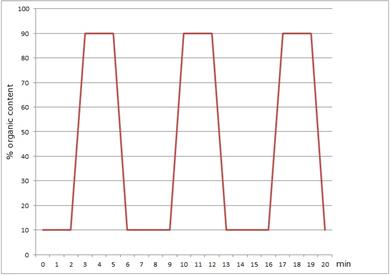
Example of a repeating column-cleaning gradient program illustrating rapid transitions between weaker and stronger mobile phase conditions. Repeated gradient cycles can help remove strongly retained contaminants and restore column performance.
Monitoring Cleaning Effectiveness
A useful way to evaluate cleaning effectiveness is to observe the chromatogram during successive cleaning cycles. Indicators that cleaning is working may include:
- Reduced baseline disturbances
- Fewer contaminant peaks
- Lower carryover
- Improved detector stability
- More consistent retention behavior
With each cycle, contaminant-related responses often diminish if the retained materials are being successfully removed.
Avoiding Precipitation Problems
During aggressive cleaning procedures, solvent compatibility must always be considered. Certain compounds may precipitate when exposed to highly organic mobile phases. Potential examples include:
- Phosphate buffers
- Salts
- Some biological residues
- Certain sample preparation reagents
For this reason, extreme solvent compositions may not always be appropriate. Care should be taken to maintain conditions that keep contaminants dissolved while still providing sufficient cleaning strength.
Before and After Column Use
Column cleaning may be beneficial both:
Before Analytical Use
Cleaning may help:
- Remove storage solvents
- Eliminate residual contaminants
- Establish stable chromatographic performance
After Analytical Use
Cleaning may help:
- Remove accumulated sample residues
- Reduce carryover
- Preserve column efficiency
- Extend overall column lifetime
Routine cleaning is often an important part of preventive column maintenance.
Applications That Frequently Benefit from Cleaning
Gradient-based cleaning procedures are commonly useful for:
- Biological samples
- Environmental extracts
- Pharmaceutical analyses
- Food and beverage applications
- Complex sample matrices
- High-throughput laboratories
These applications often expose columns to materials that are more difficult to remove under normal analytical conditions.
Best Practices
To maximize column longevity:
- Use guard columns when appropriate.
- Filter samples thoroughly.
- Remove precipitated materials before injection.
- Flush columns after difficult sample types.
- Monitor pressure and performance trends.
- Perform routine cleaning before significant contamination accumulates.
Preventive maintenance is generally more effective than attempting to recover a severely fouled column.
Conclusion
Strong solvent washes remain an important tool for HPLC column maintenance, but gradient-based cleaning techniques can often improve the removal of strongly retained contaminants by repeatedly disrupting stationary phase equilibrium. Properly designed cleaning gradients may reduce carryover, improve baseline stability, restore chromatographic performance, and extend column life. When combined with good sample preparation and routine maintenance practices, these procedures can help maintain reliable column performance over the long term.